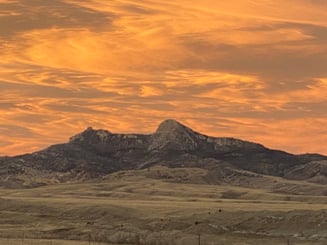
Located a few miles north of Cody, Heart Mountain stands as a symbolic feature for all areas of Park County. However, many residents and visitors might not know that this mountain is actually upside down! While most land masses have newer rock on top of the older rock, the area on the top of Heart Mountain is much older than the stone at the bottom.
Geologist Thomas Hauge said, “Despite more than 100 years of study, the Heart Mountain Detachment remains among the world’s most puzzling geological structures.”
Geologists estimate that the summit of the Heart Mountain Detachment (yes, detachment!) is made of Paleozoic sedimentary rock (up to 570 million years old), and its base is made of Cenozoic sedimentary rock (approximately 65 million years old). Moreover, similar formations were found nearly 60 miles away in Yellowstone National Park.
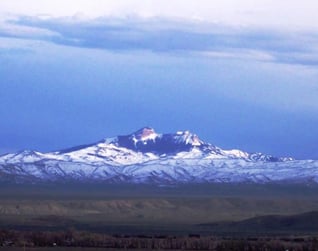
Geologists have several theories to describe what happened nearly 50 million years ago. Usually, when older mass is above newer rock, geologists can assume that folding of the rock occurred (due to intense pressure, temperatures or stress). However, geologists have theorized that a volcanic eruption created the Heart Mountain formation.
It has been theorized that the original block of rock was shattered into at least 50 large pieces and scattered over an area greater than 3,400 square kilometers. Bob Carson, a Geology professor from Whitman College, told the Cody Enterprise that the Heart Mountain Detachment traveled 60 miles from the initial explosion. Another piece of the exploded rock advanced an additional 30 miles to the east and is now known as the McCullough Peaks.
“The mass that slid was more than 1,000 miles in area and about a mile thick,” Carson told the Enterprise.
There are many theorize that explain how quickly the slide occurred. Some geologists have suggested that the slide occurred catastrophically, with the masses moving at 280-760 mph. And while some theorize that the event took 30 minutes to occur, others argue that the slide happened much slower.
Maybe we’ll never know what really happened, but we can still admire and appreciate the geological mystery in our own backyard. As the weather gets warmer, put on your hiking boots and hit the Class 1 Heart Mountain Trail. This 7.6 mile round-trip trail provides a great workout and some scenic views of the surrounding area.
Visit http://www.summitpost.org/heart-mountain/282559 for more information about the trail and how to get to it!
.jpg)